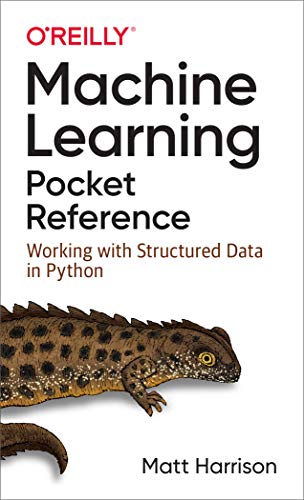

With detailed notes, tables, and examples, this handy reference will help you navigate the basics of structured machine learning. Author Matt Harrison delivers a valuable guide that you can use for additional support...

Buy Now From Amazon

Product Review

With detailed notes, tables, and examples, this handy reference will help you navigate the basics of structured machine learning. Author Matt Harrison delivers a valuable guide that you can use for additional support during training and as a convenient resource when you dive into your next machine learning project.

Ideal for programmers, data scientists, and AI engineers, this book includes an overview of the machine learning process and walks you through classification with structured data. You’ll also learn methods for clustering, predicting a continuous value (regression), and reducing dimensionality, among other topics.

This pocket reference includes sections that cover:

  • Classification, using the Titanic dataset
  • Cleaning data and dealing with missing data
  • Exploratory data analysis
  • Common preprocessing steps using sample data
  • Selecting features useful to the model
  • Model selection
  • Metrics and classification evaluation
  • Regression examples using k-nearest neighbor, decision trees, boosting, and more
  • Metrics for regression evaluation
  • Clustering
  • Dimensionality reduction
  • Scikit-learn pipelines


Similar Products

Hands-On Machine Learning with Scikit-Learn, Keras, and TensorFlow: Concepts, Tools, and Techniques to Build Intelligent SystemsPractical Time Series Analysis: Prediction with Statistics and Machine LearningHands-On Unsupervised Learning Using Python: How to Build Applied Machine Learning Solutions from Unlabeled DataData Science from Scratch: First Principles with PythonDeep Learning from Scratch: Building with Python from First PrinciplesGenerative Deep Learning: Teaching Machines to Paint, Write, Compose, and PlayIllustrated Guide to Python 3: A Complete Walkthrough of Beginning Python with Unique Illustrations Showing how Python Really Works. Now covering Python 3.6 (Treading on Python) (Volume 1)Deep Learning Illustrated: A Visual, Interactive Guide to Artificial Intelligence (Addison-Wesley Data & Analytics Series)Programming PyTorch for Deep Learning: Creating and Deploying Deep Learning ApplicationsStorytelling with Data: Let's Practice!